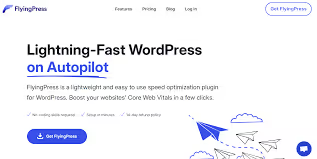
FlyingPress
Key Applications
- Full page caching and cache preloading on content changes.
- Asset optimization: minify, defer, remove unused CSS, delay script execution.
- Lazy loading for images, iframes, HTML elements, videos.
- FlyingPress+1Font optimization: self-host, preload, combine Google Fonts. Improve layout stability: set image dimensions, reduce layout shifts.
Who It’s For
FlyingPress is ideal for site owners, bloggers, agencies, and developers who prioritize real-world performance and want to consolidate optimization tools into a single plugin. It fits those who are tired of stacking many plugins just to optimize speed and Core Web Vitals. Beginners can benefit from safe defaults, while more technical users will appreciate the fine control over CSS/JS and rendering. It’s especially good for performance-conscious sites (blogs, eCommerce, membership) that need to maintain speed under load.
Pros & Cons
| Pros |
Cons |
| ✔️ All-in-one solution: caching, render optimization, asset control in one plugin. |
✖️ No free version; entirely paid only. :contentReference[oaicite:19]{index=19} |
| ✔️ Strong control over CSS/JS (unused CSS removal, lazy render) beyond typical caching. :contentReference[oaicite:20]{index=20} |
✖️ Learning curve for advanced optimizations on complex, dynamic sites. :contentReference[oaicite:21]{index=21} |
| ✔️ Good default settings for beginners, with safety in mind. :contentReference[oaicite:22]{index=22} |
✖️ FlyingCDN (optional CDN) incurs extra cost / complexity. :contentReference[oaicite:23]{index=23} |
| Pros |
Cons |
| ✔ Very beginner-friendly |
✖ Limited features compared to Others |
| ✔ Clean interface |
✖ Less feature depth than others |
| ✔ Helpful community and resources |
✖ Can feel slower at scale |
How It Compares
- Versus WP Rocket: FlyingPress tends to give stronger optimization control (unused CSS, lazy render) while WP Rocket has a more mature ecosystem and broader integrations.
- Versus Perfmatters: Perfmatters focuses on script control and bloat removal, while FlyingPress combines caching + asset management + rendering features in one.
- Versus combining multiple speed plugins: FlyingPress replaces multiple separate plugins (caching, CSS/JS control, lazy loading) with an all-in-one approach, reducing plugin overhead.
Bullet Point Features
- Page caching, cache preloading, and automatic cache regeneration.
- FlyingPressRemove unused CSS and generate critical CSS.
- Delay script execution, defer scripts, and advanced JS control.
- Lazy loading images, videos, iframes, and DOM elements.
- Font optimization: combining, preloading, self-hosting.
- Link preloading (preload links before user click) and resource prioritization.
Frequently Asked Questions
Find quick answers about this tool’s features, usage ,Compares, and support to get started with confidence.
What is FlyingPress and what does it do?

FlyingPress is a WordPress performance optimization plugin designed to speed up websites by optimizing how content, scripts, and images load. It focuses on delivering fast page load times and improving overall site responsiveness.
How does FlyingPress improve website performance?

FlyingPress improves performance by optimizing caching, delaying non-critical scripts, lazy loading images, and reducing render-blocking resources. These optimizations help pages load faster and create a smoother browsing experience for visitors.
Is FlyingPress suitable for beginners?

Yes, FlyingPress is beginner-friendly and easy to configure. It offers sensible default settings that work well for most websites, while also allowing advanced users to fine-tune performance options if needed.
Can FlyingPress help with Core Web Vitals?

FlyingPress is built to support better Core Web Vitals scores by improving loading speed and interactivity. Faster pages contribute to better user experience and stronger performance metrics.
Who should use FlyingPress and what benefits does it offer?

FlyingPress is ideal for WordPress site owners, bloggers, businesses, and developers who want faster load times. It helps reduce bounce rates, improve user engagement, enhance SEO performance, and deliver a more responsive website.