What Plagiarismly's plagiarism checker offers, what a sample scan looks like, what it costs, and how to check content for originality before you publish.
Plagiarismly is an online plagiarism checker that compares pasted text or uploaded files against web and academic sources, then returns a similarity report with highlighted passages and links to the matching sources. Paid plans start at $12 a month, and there is a free plan for short checks. It suits writers, marketers and small content teams who want a quick originality check before something goes live.
Below: what the tool does, what its results look like, a five-step workflow you can use before publishing, what it costs, and where it fits.
Why check content before it goes live
Plagiarism in business content often happens by accident. A freelancer reuses a paragraph from an old client brief. A contributor paraphrases a competitor's page too closely. A product description gets lifted from a supplier's site. A draft written with AI writing tools can echo existing pages without anyone noticing.
Any of these can cost you reader trust, a client relationship or a takedown request, and near-duplicate pages can end up competing with the original in search results. A scan is quick and catches the obvious cases before they are public.
What Plagiarismly does
You can paste text or upload a file. Plagiarismly says it compares your text with web pages, journals and research databases, including Google Scholar, ProQuest and PubMed, and that it supports more than 25 languages. The results come back as a report you can review passage by passage.
| Feature | What you get | Why it matters |
|---|---|---|
| Similarity report | Plagiarism and uniqueness scores, color-coded highlights, links to matched sources, downloadable report | You review each flagged passage instead of trusting one number |
| Match types | Exact matches, partial matches and paraphrased content | Copy-paste is the easy case. Reworded text is where checkers tend to differ |
| Citations | APA, MLA or Chicago citations for flagged sources | Helpful when the overlap is a legitimate quote |
| Exclude URLs | Up to 10 URLs on the monthly plan | Lets you exclude your own site or approved sources from a check |
| Files | Free plan: 1 file (TXT). Monthly plan: up to 10 files in DOC, DOCX, PDF, RTF, ODT, PPT, PPTX, ODP or TXT | Useful when you check several drafts at once |
| AI scan | Premium plans can scan for plagiarism and AI-generated text at the same time. A separate AI Detector tool sits next to the checker | One pass covers both questions |
| Privacy | Text is deleted once the check finishes | Relevant for unpublished client work |
| Integrations | Chrome, Edge and Firefox extensions, a WordPress plugin and an API (listed on the pricing page) | Check inside the tools your team already uses |
For more on tools built specifically for the AI question, see our AI detectors category.
Sample scan: what the results look like
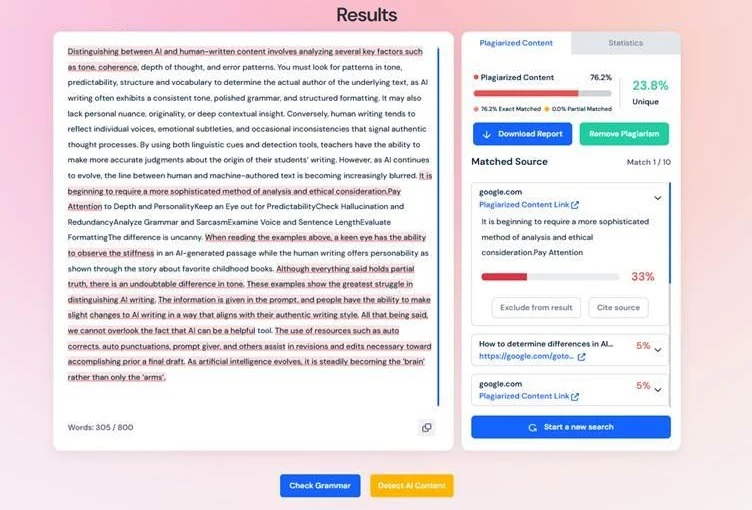
The screen is easy to read. The scanned text sits on the left with matches highlighted. The right side shows the totals (here 76.2% matched, all of it exact, and 23.8% unique) and a ranked list of sources. The top source accounts for 33% of the text. Each source can be excluded from the result or cited, and the whole report can be downloaded.
That layout is how you will use it day to day: scan, review the highlights, decide which are quotes, common phrases or real problems, then fix the real ones. A high score does not prove plagiarism on its own. Quotes, common phrases and reference lists all match other pages, so read the highlights before you judge the number.
Your pre-publish plagiarism check in five steps
This routine works with Plagiarismly or any other checker.
- Scan the near-final draft. A first draft will change, and metered plans count every rescan.
- Set aside what should match. Quotes, citations, product names and legal boilerplate will flag. Mark them as expected, or exclude your own site and approved sources in the report.
- Review each flagged passage, not just the percentage. Decide whether it is a properly credited quote, a common phrase, or text you need to rewrite from your own notes.
- Rewrite, cite or cut, then rescan only what changed. That keeps your word allowance for the next draft.
- Keep the report with the content brief. If a client or editor asks later, you have a dated record.
Set your pass mark once, per content type, and write it down. A pricing page full of product names will score differently from an opinion piece. If AI tools are part of your process, add an AI check to the same pass, either in Plagiarismly's premium plans or with a tool like Winston AI.
Pricing and plans
Prices as listed on Plagiarismly's pricing page, October 2026.
| Plan | Starting at | Billed | Word allowance (3 tiers) | Searches / pages |
|---|---|---|---|---|
| Free | $0 | n/a | 1,500 words | 3 |
| Monthly | $12 | every month | 30,000 / 80,000 / 140,000 | 100 |
| Semi-annual | $60 | every 6 months (about $10 a month) | 180,000 / 480,000 / 840,000 | 600 |
| Annual | $120 | every year (about $10 a month) | 360,000 / 960,000 / 1,680,000 | 1,200 |
The prices are starting prices. Each paid plan offers three word-allowance tiers, and larger allowances may cost more than the starting price, so check the price for your tier on Plagiarismly's pricing page before you subscribe. The checker box on the site shows an 800-word cap per free check.
Free vs paid
- Free: 1,500 words, 3 searches and one TXT file at a time.
- Paid, from $12 a month: 30,000 words or more, 100 to 1,200 searches depending on the plan, up to 10 files at once in formats such as DOC, DOCX and PDF, URL exclusions, two user seats and priority support.
New users also get a five-day money-back guarantee, and you can pause a subscription instead of canceling it. The smallest monthly tier lists 30,000 words, roughly 20 articles of 1,500 words. Because plans count total words checked, rescans draw from the same allowance.
How the price compares
Our Tool Pages list Winston AI, mainly an AI detector with plagiarism credits, at $18 a month billed monthly or $10 a month billed yearly. Grammarly, a full writing assistant, is $30 a month billed monthly or $12 a month billed annually, per seat. Plagiarismly starts at $12 billed monthly, or about $10 a month on its longer plans. Copyleaks, Originality.ai and Turnitin price by user, credits or institution, so they don't line up cleanly here.
Strengths and limits
What works well
- The report is easy to act on, with highlights, ranked sources and a per-source option to exclude or cite.
- The entry price is low: from $12 a month, or from about $10 a month on the longer plans.
- Exclude URLs, a citation generator and wide file support suit editors and agencies.
- A five-day refund window and a pause option lower the risk of trying a paid plan.
Where it falls short
- The free plan is small: 1,500 words, 3 searches and one file at a time.
- Word allowances are metered, so rechecking drafts uses them up.
- Bulk upload is capped at 10 files on the monthly plan, and the pricing page does not state bulk limits for the longer plans.
Who it fits, and who should look elsewhere
Plagiarismly suits freelancers, small marketing teams, agencies and site owners who vet contributor posts: anyone who needs a quick report to hand to an editor or client. For content creators, the low entry price and readable report are the main draw.
Look elsewhere in a few cases. If you need school or institution-level checks, Turnitin is built for that. If you want plagiarism and AI-content checks from one vendor, compare Copyleaks and Originality.ai. If you would rather have a check inside your writing tool, Grammarly includes one in its paid plan.
FAQ
Is Plagiarismly free?
Yes, there is a free plan with 1,500 words and 3 searches. Paid plans start at $12 a month.
Does Plagiarismly check for AI-generated text?
Premium plans can scan for plagiarism and AI at the same time, and the site also has a separate AI Detector tool.
Can I exclude my own website from a check?
Yes. The monthly plan lets you exclude up to 10 URLs, which helps when you reuse your own published material.
Does a high similarity score mean I plagiarized?
No. Quotes, common phrases and references all create matches. Review each highlighted passage before deciding what to change.
Bottom line
Plagiarismly is a low-cost, straightforward way to run an originality check before you publish, and its report is easy to work from.
Best for: freelancers, small marketing teams and agencies that want a quick pre-publish check and a report they can hand to an editor or client.
The catch: the free plan is small, allowances are metered so every rescan uses words, and the pricing page doesn't itemize price by word tier. Try the free plan on a typical draft, then pick the tier that matches how much you publish.